
Is PLA Really Easier to Work With Than PETG? The Key Differences in 3D Printing
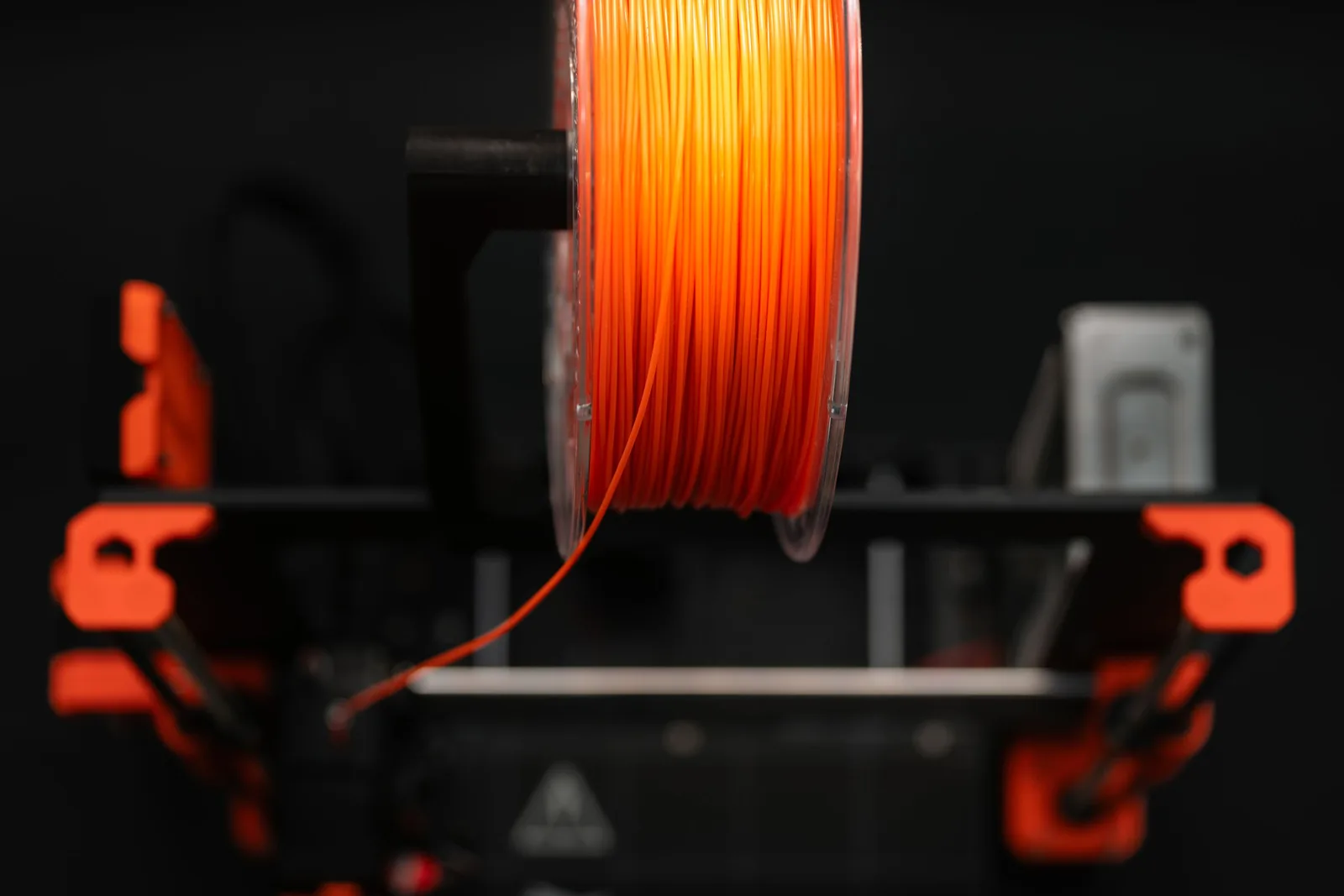
The short answer: yes, in general, PLA is easier to print reliably at a good quality level, especially if you’re just getting started with FDM 3D printing.
That doesn’t mean PETG is a “worse” material, though. Quite the opposite: PETG has a number of properties that make it the better choice for functional, mechanically loaded parts more often than not.
The difference mostly comes down to the two materials offering different tradeoffs. PLA is easier to print and generally produces a nicer, more detailed surface finish, while PETG is tougher, more flexible, and handles heat better. Prusa’s own material guide lists PLA among the easiest materials to print, while describing PETG as also easy to print but primarily suited to technical parts.
PLA vs. PETG: What’s the Core Difference?
PLA (polylactic acid) and PETG (glycol-modified polyethylene terephthalate) are both common FDM materials, but their printing and in-use properties diverge.
| Property | PLA | PETG |
|---|---|---|
| Printability | Very easy | Easy, but needs more tuning |
| Detail level | Very good | Good |
| Stringing | Less common | More common |
| Warping | Low | Low |
| Layer adhesion | Good | Very good |
| Toughness | More limited | Better |
| Flexibility | Stiffer, more brittle | More flexible |
| Heat resistance | Low | Higher |
| Outdoor use | Limited | Better, but not ideal for every condition |
| Mechanical parts | Sometimes suitable | Generally more favorable |
| Beginners | Specifically recommended | Also suitable |
This table is naturally a generalization: individual filament manufacturers’ formulations, additives, and specific product variants can differ significantly.
Why Is PLA More Beginner-Friendly?
One of PLA’s biggest advantages is that it prints well across a relatively wide range of settings, while causing few problems around geometry and cooling setup.
Per Prusa’s recommendations, PLA typically prints in roughly a 185–235 °C nozzle range and a 50–60 °C bed range, though the exact values naturally depend on the filament and machine.
With PLA, you generally get:
- less warping trouble,
- easier printing of sharp details and small features,
- good results with strong cooling,
- an easier time finding the right temperature,
- a surface that’s typically less prone to the “fuzzing” and stringing common with PETG.
This matters especially when the goal is a visual prototype, presentation piece, model, or a highly detailed part.
That said, PLA isn’t popular because it’s better at everything. Alongside its easy printability come limitations that show up quickly on functional parts.
PLA’s Biggest Weakness: Heat
PLA’s heat resistance is limited compared to PETG. Per Prusa’s guide, PLA parts can start to soften and deform above 60 °C, making it a poor choice wherever operating temperatures run higher.
This matters more in practice than it might seem at first.
A part that’s perfectly rigid and dimensionally stable at room temperature can lose the stiffness it needs once it’s in a car, inside machinery housing, in direct sunlight, or near a warmer piece of equipment.
That’s why you need to look at mechanical load and thermal load together, not just whether the model “looks strong enough.”
Why Can PETG Be Trickier to Print?
Interestingly, PETG can be considered both an easy and a difficult material to print, depending on what you’re looking at.
Prusa specifically describes it as easy to print, while also listing several typical problems: PETG is prone to stringing, bridges and overhangs can come out weaker, and it can adhere very aggressively to the print surface.
1. Stringing and Oozing
With PETG, it’s common for thin plastic strands to trail between the part and the nozzle as it travels.
This tends to become especially visible with:
- models made of several separate islands,
- lots of travel moves,
- high nozzle temperatures,
- filament that’s absorbed moisture.
Proper retraction settings, travel speed, temperature, and drying the filament can noticeably improve the result.
2. Excessive Bed Adhesion
One of PETG’s advantages is also, in some cases, a drawback: it can bond to the build plate extremely well.
That’s an advantage for functional parts, since there’s less risk of layer separation. But it can also stick too aggressively to the build plate itself.
That makes the print surface especially important. Prusa, for instance, warns that on certain smooth PEI surfaces, PETG’s strong adhesion can even damage the sheet.
3. Harder Bridges and Fine Details
PETG generally behaves in a “stringier,” more fluid way, and handling bridges and certain overhangs can be harder than with PLA.
So for a highly detailed model, PETG isn’t necessarily the first choice.
So Why Do So Many People Still Use PETG?
Because when a print needs to not just look good, but actually work, PETG is often the more advantageous choice.
PETG behaves in a tougher, more flexible way, so it’s less prone to brittle failure under load or impact. Thanks to its good layer adhesion and low tendency to warp, it’s a common material for mechanical parts, brackets, clamps, and other functional elements.
Here’s an important distinction:
High stiffness isn’t the same thing as high toughness.
A PLA part can be very rigid while still being more prone to breaking under a sudden impact or load. PETG, by contrast, tends to respond somewhat more flexibly to load.
That’s not to say every PETG part outperforms every PLA part, of course. The actual mechanical properties depend on the specific filament, its additives, print orientation, layer height, infill, and a range of other factors.
When Should You Choose PLA?
PLA is a good starting point when the top priority is easy printability, detail, and appearance.
Typical applications:
- visual prototypes,
- form and ergonomic models,
- presentation pieces,
- scale models,
- decorative elements,
- simple, lightly loaded parts,
- dimensional-check prototypes.
PLA is particularly practical for fast iteration: if the main thing you need to verify early in product development is whether the geometry, fit, or design is right, there’s often no need to reach straight for a pricier or harder-to-handle engineering material — our rapid prototyping service is built exactly around that need.
When Is PETG the Better Choice?
It’s worth switching to PETG once the product actually needs to do a job functionally.
For example:
- machine components,
- brackets and mounting consoles,
- housing panels,
- cable fasteners,
- mechanically loaded plastic parts,
- workshop and production-support tooling,
- larger functional parts.
Here, PETG can be a good compromise between printability and technical properties.
You don’t automatically need to jump to a technical, industrial filament just because a part is functional. PETG is often the right call, and it’s significantly simpler to work with than, say, ABS, ASA, or nylon.
When Should You Move Past PETG?
PETG isn’t a universal solution.
If, for example:
- the part needs long-term outdoor durability,
- it’s exposed to higher operating temperatures,
- it will see significant UV exposure,
- specific chemical resistance is required,
- high stiffness or strength is needed,
- long-term dimensional stability matters,
- or the part is safety-critical,
then it’s worth looking at other materials — we cover the outdoor, UV-exposed case in a dedicated article, since the assumption that “PETG is fine outdoors” often isn’t enough on its own.
ASA
ASA is a good choice for outdoor applications, since it offers better UV and heat resistance than PLA, making it the more logical pick for outdoor parts more often than not. Prusa’s own material guide also lists it specifically as a technical material suited to outdoor use.
ABS
ABS can also handle higher heat loads better than PLA, but it generally needs more care to print. An enclosed printing environment often helps reduce warping and stabilize production.
Engineering Filaments
For certain applications, the question isn’t really PLA or PETG anymore, but rather which of these fits the requirements:
- PA / nylon,
- PC / polycarbonate,
- PEEK or PEKK,
- PPSU,
- glass- or carbon-fiber-reinforced material.
In these cases, simply hunting for “the strongest filament” isn’t enough. The right material needs to be chosen based on operating temperature, load, impact resistance, chemical environment, UV exposure, allowable deformation, and manufacturing process.
Choosing a 3D Printing Material Doesn’t Start With Picking a Filament
In an industrial setting, it’s worth flipping the question around.
The first thing to ask isn’t:
“PLA or PETG?”
It’s:
“What does this part actually need to survive?”
At minimum, it’s worth defining these before choosing a material:
- How much mechanical load will it see?
- What temperature will it operate at?
- Is the load static or dynamic?
- Does it need impact resistance?
- Will it be exposed to UV?
- Will it come into contact with oil, fuel, cleaning agents, or other chemicals?
- What level of dimensional accuracy is required?
- How many units need to be produced?
- What manufacturing time and per-part cost are acceptable?
Only after that does it make sense to pick a material.
What About Industrial Manufacturing?
In industrial or short-run manufacturing, the PLA-or-PETG question is really just one part of a bigger problem.
It’s not only material properties that matter — quantity, cycle time, orientation, required post-processing, dimensional accuracy, and total manufacturing cost all come into play too.
A given geometry might be simplest to produce in PLA, but the operating environment might require PETG instead. In another case, PETG might look sufficient at first, but heat or UV exposure might make ASA the better choice. And some applications don’t get adequate performance from either.
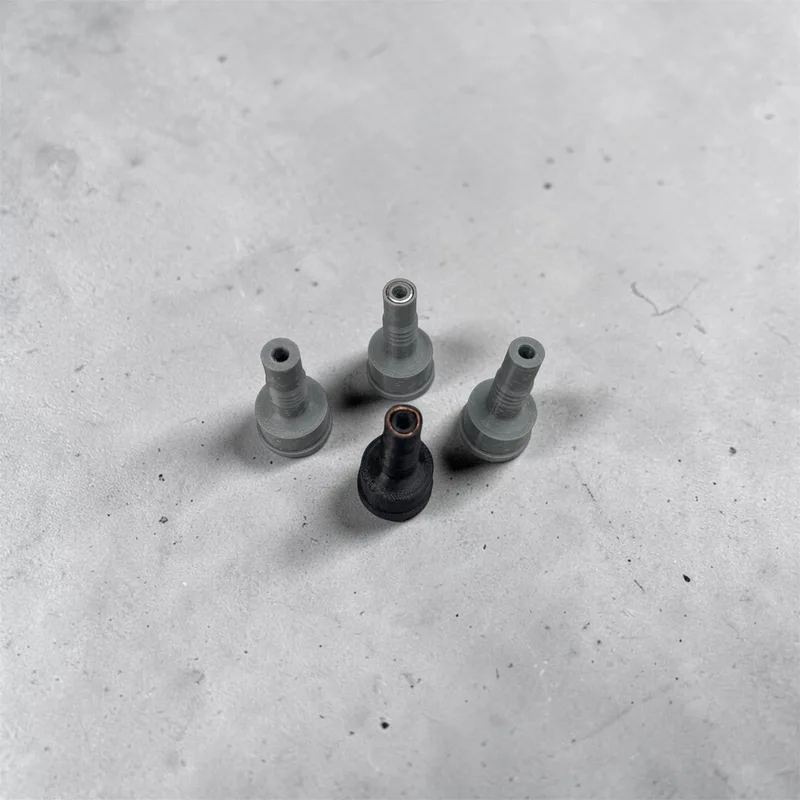
We ran into exactly this question on a real project: remanufacturing a repeatedly failing pipe adapter for a laundry facility’s chemical dosing system, where the geometry and mechanical load alone could have been handled by PLA, but continuous chemical exposure ruled that out entirely. Our case study on remanufacturing the chemical-resistant pipe adapter covers why we landed on PETG, and how we reinforced the critical, thin-walled neck section with an embedded copper insert.
At BWE Mechanical Design, industrial 3D printing and engineering design are never just about “printing” an existing STL file. The right combination of material, manufacturing process, and design is what actually determines whether a part will hold up in real-world use.
Summary
Yes, PLA is generally easier to work with than PETG. It’s more beginner-friendly, prints well, produces detailed results, and is ideal for many visual prototypes.
PETG, on the other hand, can demand a bit more attention around stringing, nozzle and bed adhesion, and fine geometric detail — but it can offer real advantages in toughness, flexibility, layer adhesion, and heat resistance.
So the real question isn’t “which filament is better?” It’s:
PLA → when you want to print simply and cleanly.
PETG → when the part actually needs to perform a function and carry more load.
ASA / ABS / engineering filament → when the environment or mechanical requirements go beyond what PETG can deliver.
The most important consideration in choosing a 3D printing material is always whether the material’s properties actually match the real application — not which filament happens to be the easiest one to print. Not sure whether PLA, PETG, or an engineering filament is the right call for your part? Request a quote for our parts manufacturing service — our engineering team will help you pick the right technology and material.
Related Articles
Planning a Similar Project?
Send us your model or drawing — free consultation, with personalized quotes within 24 hours.