
Remanufacturing a Chemical-Resistant Pipe Adapter with Hybrid PETG-Copper 3D Printing
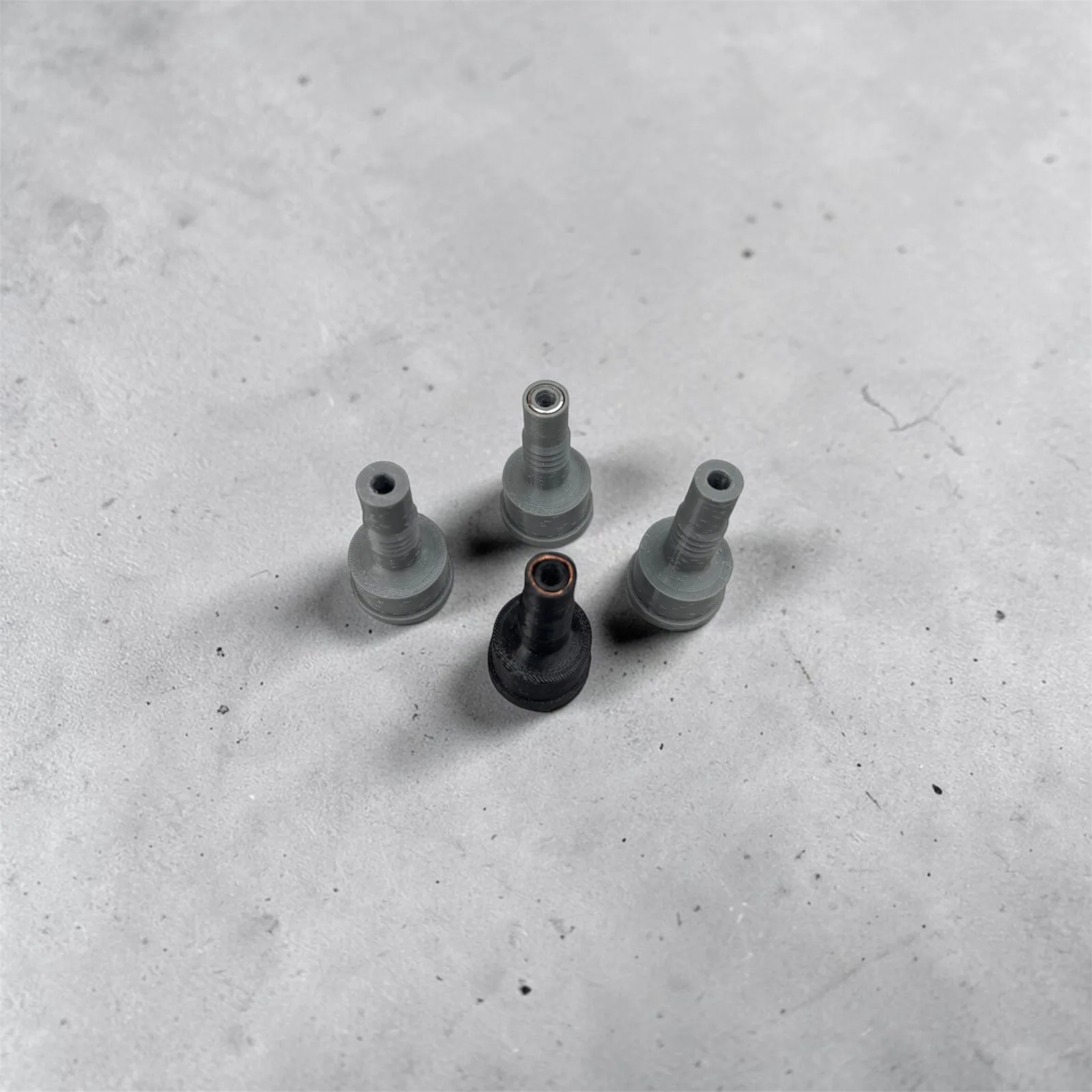
A single small plastic part failing repeatedly can cause serious downtime and real damage — especially where continuous chemical exposure, mechanical load, and material aging all come into play at once. That’s exactly the problem one of our clients brought to us: at first glance, a simple pipe adapter replacement. The reality turned out to be more complex. Professional parts manufacturing, engineering reverse-modeling, and industrial FDM technology, applied with the right mindset, can solve problems traditional part remanufacturing simply doesn’t answer.
The problem: when a tiny part causes serious damage
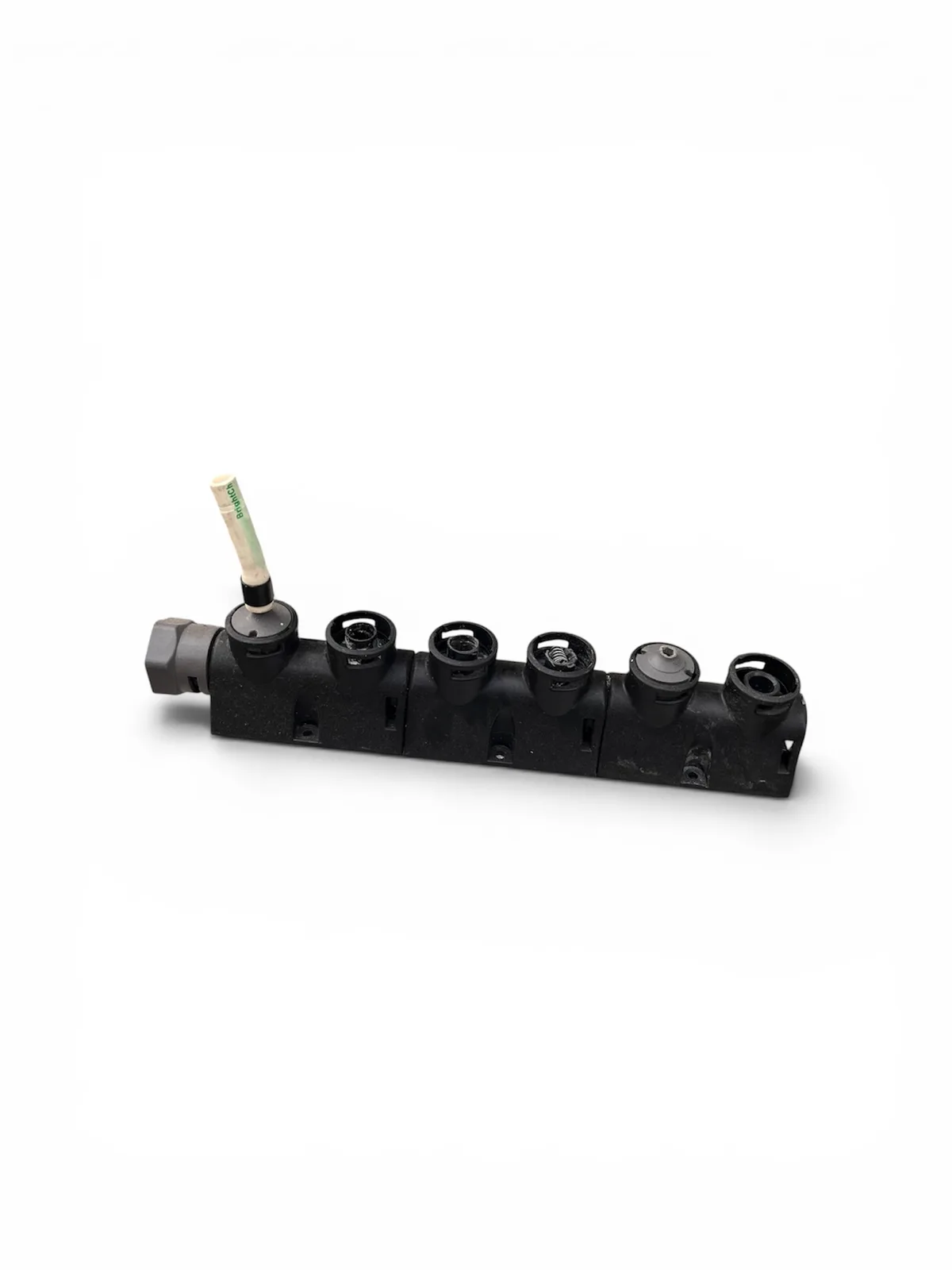
Our client needed a durable fix for a chemical-dosing system running in a laundry facility. At the heart of the system sits a fluid distribution hub, to which several pipe adapters connect — constantly exposed to aggressive chemicals, under mechanical load and pressure, running for long stretches at a time. The original injection-molded adapters lost their mechanical properties over time as the chemicals gradually degraded the material structure, making it brittle.
The failure showed up in the same spot every time: the adapter’s neck snapped off. That broke the seal, chemical leaked out of the equipment, and the system had to be shut down immediately.
Why replacing the original part wasn’t the answer
The obvious first thought is sourcing the original part. Two problems got in the way. The connector heads weren’t sold separately — in many cases the only option was buying the entire distribution unit, which would have driven the repair cost up significantly. (Situations where tooling or a complete-unit replacement is disproportionately expensive relative to one small part are more common than you’d think — we’ve written about that in more detail.) And even if the original part had been available, the geometry, material, and chemical load wouldn’t have changed — the new part would fail in the exact same spot again within a few years. So the goal wasn’t a simple replacement, but a more durable design.
The challenge: why a plain 3D-printed copy isn’t enough
It’s tempting to assume you just copy the part and print it — industrial practice is more demanding than that. This project stacked several serious challenges at once:
- Extremely thin wall thickness. The original wall thickness at the critical neck was only 2–3 mm, and the geometry couldn’t change, since the adapter had to fit the existing system exactly.
- Mechanical strength. The adapter is subject to bending loads, works under internal pressure, and is under constant hose tension — a plain FDM copy wouldn’t have held up safely over the long run at this point.
- Chemical resistance. The material had to withstand the chemicals in use — not every plastic can.
- Copper couldn’t touch the chemical. A simple copper-tube reinforcement seemed like an obvious first idea, but the chemicals in use are copper-incompatible — the copper insert had to be fully isolated.
Reverse-modeling: precise measurement and CAD design
With no factory CAD model available, the first step was digitizing the part: precise measurement, followed by building the full CAD model. For this geometry — a simple, rotationally symmetric connector head — traditional measurement-based reverse-modeling was accurate enough; for more complex, free-form parts we typically bring in 3D scanning as a supporting tool, as we did in earlier projects like a VW Golf 2 throttle lever or a motorcycle fog-light bracket. On this project, reverse-modeling wasn’t just copying — the goal was to design a better part.
Material selection: why PETG and FDM
Several additive manufacturing processes exist — MSLA, SLS, MJF among them — but FDM turned out to be the best choice for this application. PETG offers excellent chemical resistance and is one of the best FDM materials for layer adhesion. With the right print parameters it can also produce watertight parts, making it an ideal choice for a fluid-carrying system.
The real innovation: hybrid part design with a copper insert
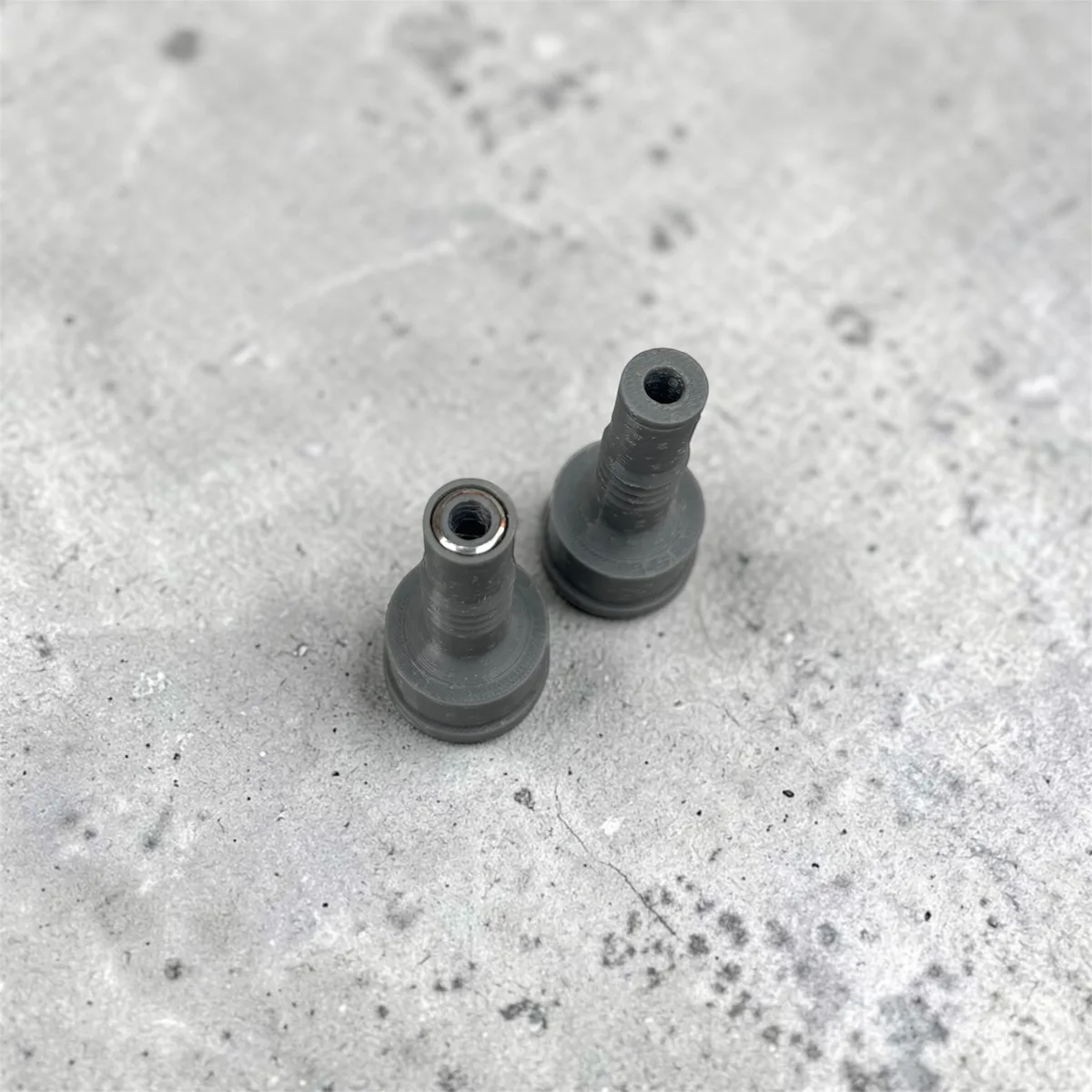
The most important part of this project wasn’t the 3D printing itself — it was the new design. Instead of simply copying the original part, we developed an entirely new reinforcement concept: we hollowed out the critical neck section internally and fitted it with a precision-machined copper tube insert. The key requirement was that the copper never touch the chemical, from either the inside or the outside — the insert is fully surrounded by PETG, so the fluid only ever contacts plastic, while the internal metal reinforcement significantly increases the structure’s strength.
The reinforcement isn’t added after the fact: at a predetermined point in the print, we pause to insert the copper tube, then resume printing so the PETG fully encloses it. As a result, the insert becomes an integral part of the component — it can’t shift, can’t work loose, and never comes into contact with the chemical.
The result: longer service life, greater reliability
The new design delivered significantly increased mechanical strength, a chemical-resistant surface, a longer expected service life, and fast remanufacturability — and since the adapters can now be replaced individually, there’s no longer any need to replace the entire distribution unit over one failed part.
Summary
This project shows that the real value of industrial 3D printing isn’t the manufacturing technology on its own — it’s the engineering behind it. Reverse-modeling, the right material choice, and a hybrid structure together produced a part that’s more durable and more reliable than the original factory solution — much like how a targeted material upgrade let us surpass the original’s performance on an engine-bay throttle lever.
If aging, no-longer-available, or repeatedly failing plastic parts are a recurring problem at your company, remanufacturing the original part isn’t necessarily the best solution. Get in touch for a quote on custom parts manufacturing — our engineering team supports your project from initial assessment through to series production as part of our parts manufacturing service.
Related Articles
 Reverse Engineering Remanufacturing a Restaurant Pager's Rubber Frame with TPU 3D Printing
  Reverse Engineering Remanufacturing a Motorcycle Fog Light Bracket with 3D Scanning and PA12-CF15 Printing
  Reverse Engineering Remanufacturing a VW Golf 2 Throttle Lever with 3D Scanning and PA12-CF15 Printing
 Planning a Similar Project?
Send us your model or drawing — free consultation, with personalized quotes within 24 hours.