
3D Printing Speed in Practice — What Does 600 mm/s Actually Mean?
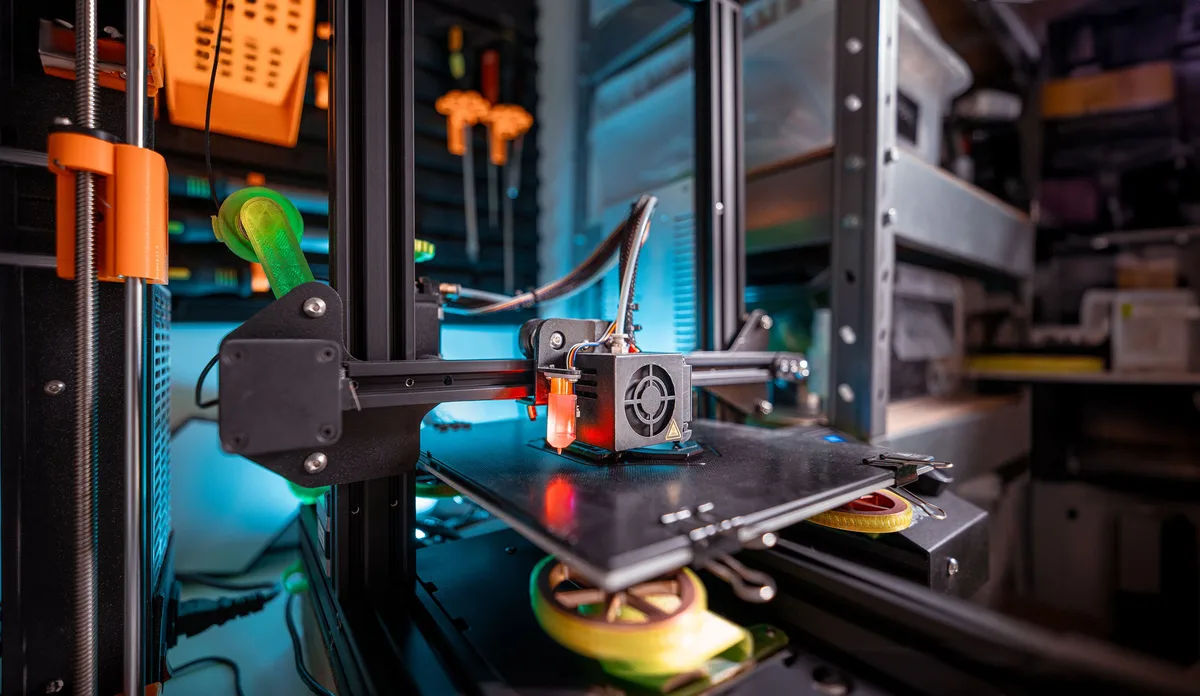
Marketing material for modern FDM 3D printers increasingly touts print speeds of 500–600 mm/s. At first glance, that’s an impressive number — but does a machine like that actually print that much faster in practice, or is it just a good-looking marketing figure?
The short answer: sometimes it matters, but the real print time is set by very different factors. This article walks through the technical parameters that actually determine 3D printing speed, and what to look for when choosing a technology or supplier for industrial parts manufacturing.
Why Top Speed Alone Is Misleading
Most manufacturers quote the printer’s theoretical maximum travel speed — but that’s only an upper bound the machine can approach during very long, straight moves. Most industrial parts, however, contain holes, fillets, ribs, small details, and steep angles, where the print head is almost constantly accelerating and decelerating. As a result, the actual average speed is often only a fraction of what the spec sheet shows.
Acceleration: The First Limit
The print head can’t jump from zero to 600 mm/s instantly — during every move, the machine accelerates, reaches peak speed, then decelerates before the next direction change. If a move is too short, there simply isn’t enough distance for the machine to reach top speed. This is especially true for small parts, complex geometry, and thin walls.
Maximum acceleration is essentially a product of the printer’s mechanical design: the mass of the print head, the drivetrain and belt stiffness, the linear rails, motor power, and frame rigidity all play a role. The lighter the moving mass, the higher the achievable acceleration — which is why modern CoreXY systems can be significantly faster than traditional Cartesian machines.
A simple example: if a printer can hit 600 mm/s with 20,000 mm/s² of acceleration, it’s physically impossible to reach that speed over a 10 mm straight segment — by the time the head speeds up, it already has to slow down again. Real average speed in that case can end up around 100–200 mm/s, which is why two printers with identical rated top speeds can perform very differently on complex geometry.
Volumetric Flow: The Second Limit
Suppose the printer is mechanically capable of 600 mm/s — the next question is whether it can melt and extrude enough plastic to keep up. This parameter is called Maximum Volumetric Flow, usually given in mm³/s, and it’s one of the most important figures in industrial FDM technology.
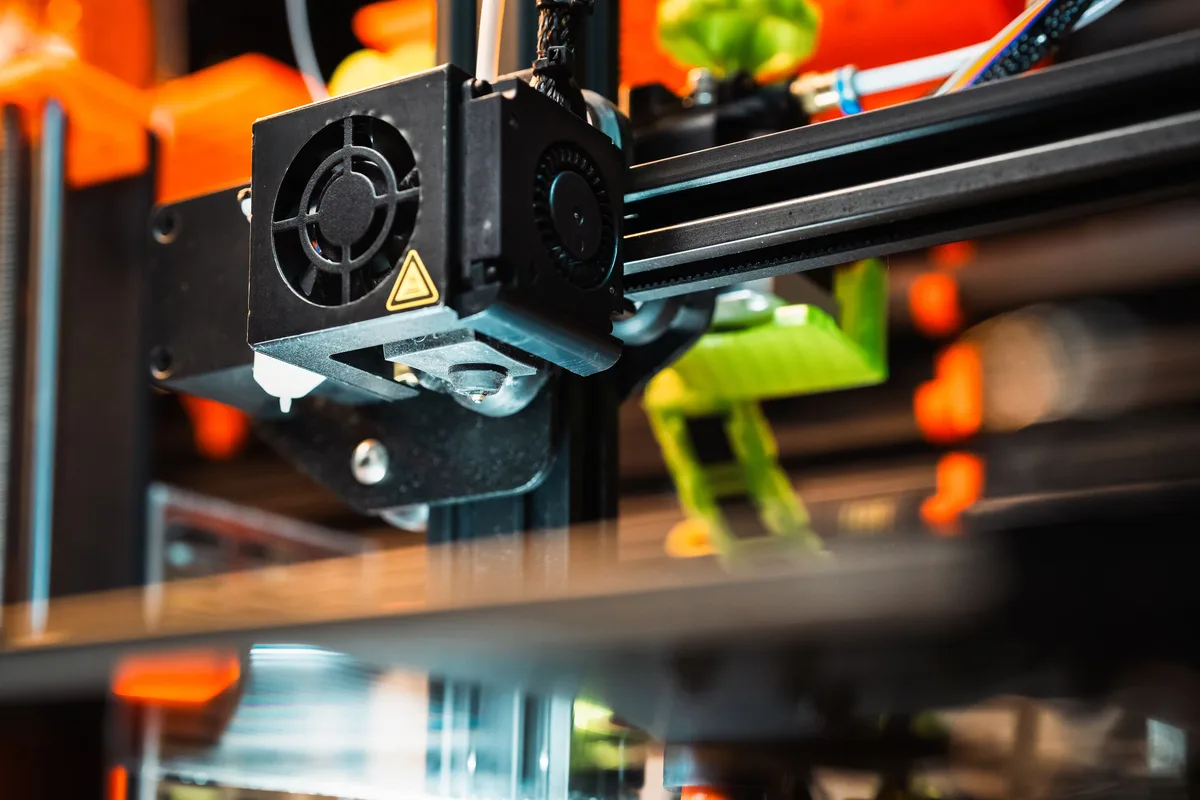
Volumetric flow depends on several factors: hotend design, melt-zone length, heater power, extruder force, filament type, nozzle size, and printing temperature. It doesn’t matter how fast the head moves if the hotend simply can’t melt enough plastic — in that case, the slicer automatically reduces speed.
This is why choosing the right hotend matters so much in professional parts manufacturing. We use high-performance systems like the Phaetus Rapido 2 UHF, designed specifically for high volumetric throughput — delivering more material flow, more stable extrusion, shorter print times, and better layer consistency at high speed. On its own, though, that still doesn’t guarantee 600 mm/s gets actually used.
Many people assume that fitting a larger nozzle is enough — the reality is more complex. A 0.6 or 0.8 mm nozzle really can pass significantly more material, but that doesn’t proportionally increase the head’s travel speed. What it can do is meaningfully cut total print time, since thicker layers and wider extrusion lines mean fewer passes are needed. That’s why, for industrial prototypes or large functional parts, it’s often more effective to use a larger nozzle than to chase speed alone.
Cooling: The Third Limit
Even with enough acceleration, the right hotend, and enough material flow, one critical factor remains: layer cooling. Freshly extruded plastic needs to solidify within the right amount of time — if it doesn’t, walls can deform, dimensional accuracy suffers, edges round off, surface defects can appear, and layer adhesion can weaken.
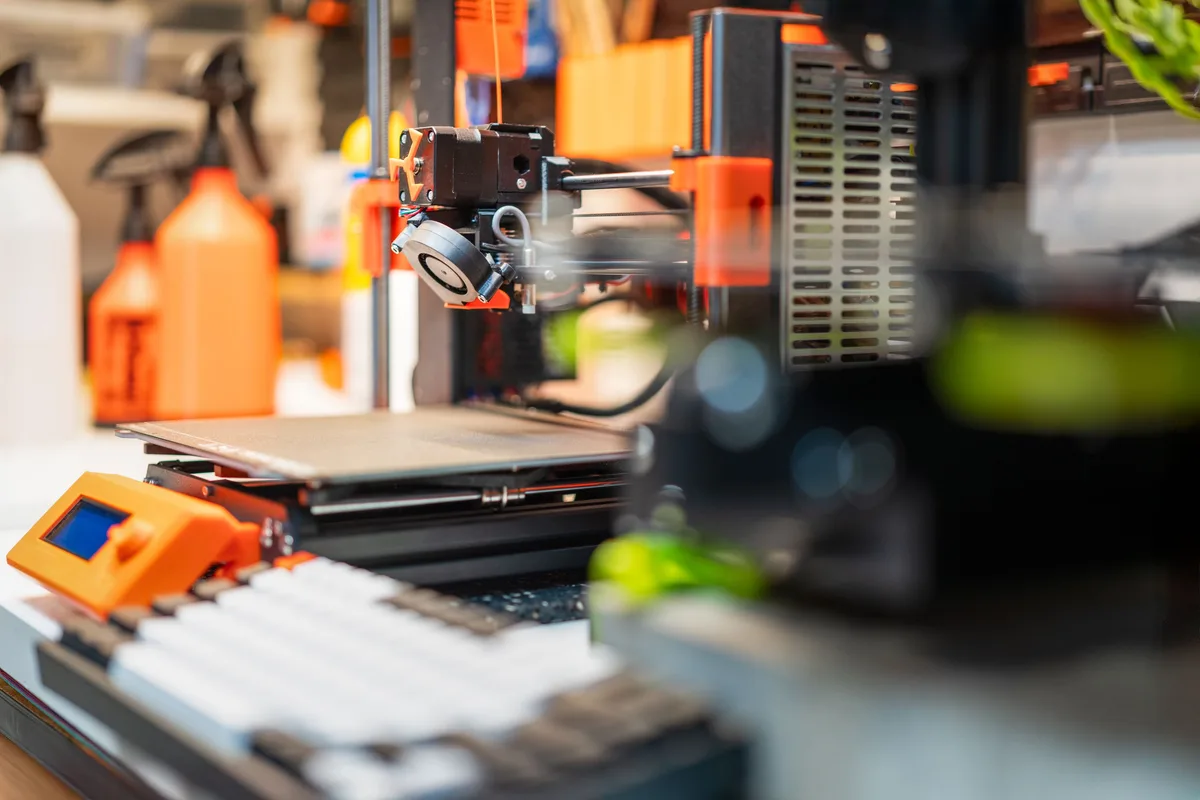
This matters especially for small parts: the print head returns to the same point very quickly, and if the previous layer hasn’t cooled back down enough, the new layer can deform it. That’s why the slicer automatically slows down in these cases — even if the machine is capable of 600 mm/s, the actual print can end up running around 50–100 mm/s.
Material Matters Too
Not every filament tolerates the same speed. PLA generally allows higher speeds, PETG is more sensitive to cooling, ASA can warp if cooled too aggressively, and engineering plastics often require a deliberate trade-off between speed and mechanical properties. That’s why industrial production always needs printing parameters optimized for the specific material.
When Does 600 mm/s Actually Matter — And When Doesn’t It?
There are cases where high speed provides a genuine advantage: large enclosures, simple box structures, prototype housings, low-detail models, and parts with long, straight walls. In these cases, the printer can sustain high speed for longer stretches, so the modern mechanics can actually be put to use.
Most industrial parts, though, are considerably more complex — mechanical components, assembly jigs, fixtures, fasteners, gears, instrument housings, custom production-line parts. These typically involve frequent direction changes, holes, and small geometric details, which is why proper acceleration, an optimal hotend, high volumetric flow, stable cooling, and precise calibration matter far more than top speed alone.
In Industrial 3D Printing, the Whole System Matters
Genuinely fast production isn’t the result of a single marketing figure — a short turnaround time comes from a well-optimized system: the right machine, tuned slicing settings, a high-flow hotend, the right nozzle, material-specific profiles, stable mechanics, properly sized cooling, and experience with the specific application. This matters even more when the job isn’t a single prototype but functional parts produced in a series — as we cover in our article on how FDM and MSLA technology actually works.
An experienced supplier doesn’t just work with “fast machines” — they optimize the entire manufacturing process. When needed, that can be complemented with 3D scanning and reverse-modeling and custom parts manufacturing, so the whole development and production chain can be handled under one roof.
Summary
600 mm/s on its own doesn’t guarantee faster 3D printing — it’s just a theoretical maximum travel speed, constrained in real production by several factors: the printer’s acceleration, maximum volumetric material flow, proper layer cooling, geometric complexity, and the material and print profile in use.
The real strength of industrial FDM technology isn’t in the headline numbers from a spec sheet — it’s in a well-coordinated system, where mechanics, material flow, cooling, and experience combine to deliver fast, reliable, reproducible parts manufacturing.
If you need a partner who doesn’t just run fast printers but optimizes the entire manufacturing process, get a quote for our parts manufacturing services — whether it’s custom parts manufacturing, functional prototypes, small-batch production, or highly detailed parts made with MSLA technology.
Related Articles
Planning a Similar Project?
Send us your model or drawing — free consultation, with personalized quotes within 24 hours.